Showing posts with label Little Fugitive. Show all posts

Wednesday, May 22, 2013

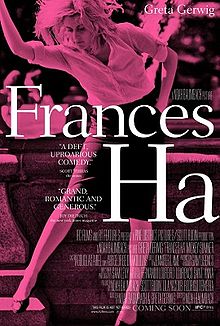
Frances Ha


“This apartment is very aware of itself,” comments one of the characters in Noah Baumbach’s Frances Ha, the director’s love song to his co-writer and leading lady, Greta Gerwig (Frances). Greta is a dancer and the movie which employs a great deal of jump cuts also lingers on Gerwig in motion whether she is philosophizing about the virtues of reading Proust in Paris which she calls doing “what your supposed to be doing when your supposed to be doing it,”falling on her way back from finding an ATM machine (a shot that moviegoers are likely to remember the film by) or merely standing in the elevator of Moishe’s self storage. About her choreography Frances says, “I like things that look like they’re mistakes,” and that is source of the love that Baumbach lavishes on his character, a poor little poor girl who looks like a poor little rich girl, a dance major from Vassar by way of Sacramento who won’t take avocation for an answer. But what might be said about the apartment could also be iterated about the movie which being shot in black and white immediately cites all your favorite French New Wave films starting with The Four Hundred Blows, Woody Allen’s Manhattan, John Cassavetes’ Faces (both shot in b&w) along with a host of earlier b&wAmerican classics that are filmic versions of the Bildungsroman, or coming of age novel. Frances even misses the opportunity of meeting a Leaud look a like on brief trip to Paris. But as much as we may admire the low definition of b&w which by failing to fill in the blanks, leaves the imagination unfettered, it’s a big leap to sit down and make your your 2013 version of Little Fugitive about a Vassar girl on the run, as it were, without invidiously comparing the film to the masterpieces it cites. You might say that there’s something contrived about the film, right down to its earnestness, minimalism and seeming lack of contrivance. Like a lot of Vassar grads, Frances gets on her feet. The chances that the character takes are like that of the filmmaker who is more calling attention to, than actually opting for, the kind of risks he would have you believe he is taking.

Monday, February 4, 2013

Little Fugitive


One of the most interesting things about Morris Engel, Ruth Orkin and Ray Ashley’s production of Little Fugitive, currently being revived at Film Forum, is that it came four years after Vittorio De Sica’s Bicycle Thieves (l948). Engel actually shot the movie in a cinema verite style with a hand held 35mm camera, not a common piece of photographic equipment at that or in any time in the history of American film. If Bicycle Thieves is an iconic piece of Italian neorealism then Little Fugitive might be sui generis example of American hyperrealism. The scene where Lenny (Richard Brewster) tries to locate his kid brother Joey (Richie Andrusco) on a crowded Coney Island beach is uncannily reminiscent of the doomed attempt to retrieve the stolen bicycle, the needle in a haystack, amongst the mountains of bicycles that fill the streets of De Sica’s post-war Rome. What makes Little Fugitive singular in American cinematic history is that it’s about objects rather than a story. Americans genuinely like their bread and butter, which is to say plot, but while Little Fugitive literally had plenty of bread and butter—in the form of cotton candy, watermelon, hot dogs and soda pop—it didn’t provide the kind of bread and butter most filmgoers generally seek. The story is rather simple, young Joey runs away when he is tricked into believing he’s murdered his older brother. Joey has his seven year old version of a Walgurgisnacht and Last Supper in one, riding on the El to Coney Island, passing signs reading “Smile It’s Worth a Million Dollars and Only Costs a Dime” and hearing shills in front of an arcade crying out “everyone knocks them down, you will too,” seeing the ferris wheel and the steeple chase and caressing the head of a merry-go- round horse. The brilliance of the film is to see guilt from the point of view of a seven-year-old and from that character’s height too. Joey survives by collecting the deposits on bottles he finds next to impervious lovers under a boardwalk or nestled into a jetty. “Why did you run away?” Lenny asks his younger brother at the end. “It was just a joke.” “Why didn’t you tell me,” Joey says and that’s a wrap. In the meanwhile Little Fugitive, awash in the imagery of the great photographer Ruth Orkin, creates its own iconography. The motto is, don’t ever underestimate the intelligence of the movie going public. Just because Hollywood plays to the lowest common denominator doesn’t mean that audiences aren’t capable of a helluva lot more (Little Fugitive opened in 5000 theaters in l953) and still can draw substantial audiences today. Little Fugitive is a great American movie that proves the point.

Tuesday, February 9, 2010

A Touch of Class

Hell’s Kitchen was famous for the Westies. Ray Ashley’s Little Fugitive (1953) depicted the mind of a child as a dangerous place. Then there’s the Russian Sector of Vienna in The Third Man, Little Rock, Arkansas in the ‘50s, The Brambles in Central Park, Bed-Stuy, South Central L.A., Sheriff’s Street in Dublin, the banlieus of Paris with their notorious public housing projects full of angry, unemployed youth from former French colonies, Northern Ireland at the height of its conflict, The Sudan, Chechnya, Rwanda, the South Side of Chicago, the favelas of Rio, and the East End of London before artists took it over. These are all famous dangerous places, where awful things occurred if you were too rich or too poor, too black or not black enough, or just in the wrong place at the wrong time. It’s still not a good idea to be a Turk in certain parts of Germany. Iran is not a good neighborhood for Jews, nor is Jerusalem a particularly good neighborhood for most Palestinians. There was a story about a white woman walking into a predominantly black area of Boston in the ‘60s and being set on fire, and the gay man chased to his death by a homophobic gang in a Brooklyn backwater. And then there's the Klan, with its Grand Wizards, who were once ubiquitous in neighborhoods throughout the Old South. There is still something ominous about downtown Jackson, Mississippi, despite its museum and its veneer of culture. There are also the defunct manufacturing hubs that drove the industrial giant that is no more. Downtown Detroit is one of those.
   
It used to be that certain socialist societies, especially in Nordic countries like Sweden, Denmark and Norway, produced such a high level of enlightenment and equality that there were no bad neighborhoods to be found, until the oppressed of the world took refuge in these utopias and created a burgeoning underclass whose resentments created their own backlash. Preston Sturges’s Christmas in July (l940) turns a working class neighborhood into a wonderfully bad neighborhood for some titans of industry who set out to reclaim what they think is stolen merchandise. Class and class culture—see Ralf Dahrendorf’s Class and Class Conflict in Industrial Society (1959)—ultimately are the qualifying factors in trying to determine whether one is on the verge of entering a bad neighborhood or whether what is bad for you is good for me. Xenophobia is a common means of social cohesion. There is honor amongst thieves and, for the dissolute, Babylon is a bastion of safety. But there are certain places where it is almost guaranteed that your ass will be whipped if you try to save souls.